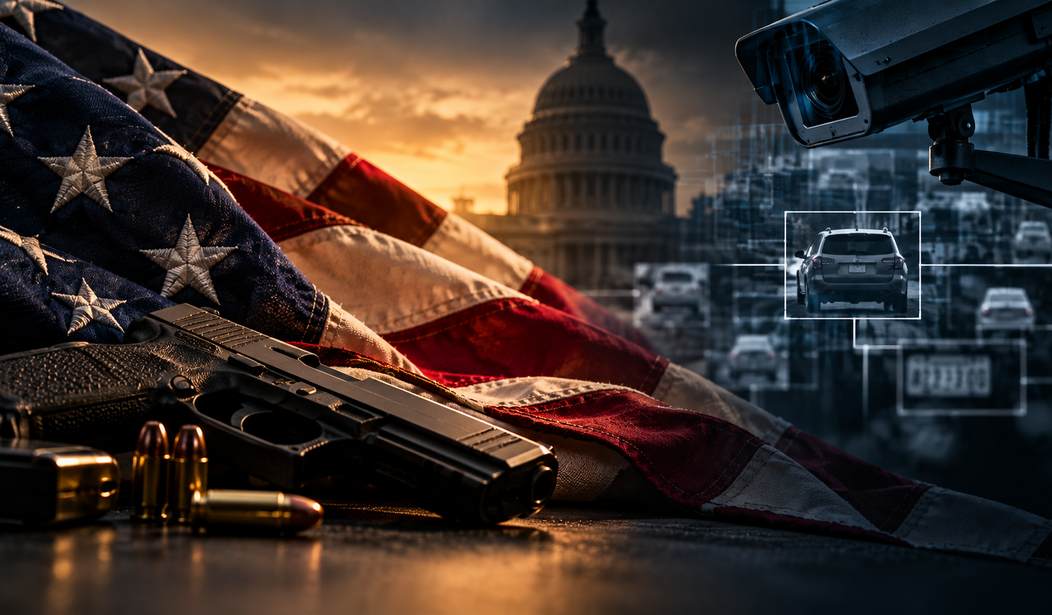
I teach women to shoot. That means I spend a lot of time at ranges. When I pull into a parking lot to train, I expect cameras on the building. I do not expect networked artificial intelligence aimed at the driveway, reading every plate that comes and goes. But that is what happened at Eagle Sports Range in Cudahy, Wisconsin.
A woman filmed several Flock Safety cameras pointed inward at the entrance, not at the street, so they could capture every vehicle entering the lot. The video went viral. The range’s general manager, Saad Jaber, said in an interview that the cameras were installed back in 2023 after break-ins at other Milwaukee area ranges. The intent was security. By February, the range asked Flock to take them down over privacy concerns. Flock cited a contract and Jaber said he had not realized they were locked in. After the video spread, the range pulled the cameras itself. “To heck with this contract, we’ll deal with that later on,” he said. Then the line that should stick: “We own our privacy, but when that privacy gets infringed, then what are we doing? What kind of nation are we going to become?”
The situation at the range today has changed. Ordinary closed-circuit cameras remained and controlled by the business remain. Honestly, no one can fault the range. Basic CCTV is not the same thing as an AI system. These systems that can log license plate numbers, make, model, color, and bumper stickers, then feed them into a searchable network law enforcement can query across jurisdictions. Flock boasts of its system developing a “vehicle fingerprint” and their system works. The scratch you got when your garbage can hit your truck; the funny sticker that your daughter gave you for Father’s Day, or even the license plate frame that came from the dealership become unique identifiers.
Now, incorporate a searchable database where users can ask directed questions “for investigative purposes” and there you have a weapon. Ironically, the system marketed on safety has the potential for the exact opposite. At this point, you have all likely seen the headlines about police officers abusing access to these databases to track, surveil, harass and even stalk spouses and ex-partners. For example, an officer in the same area as the Eagle Sports Range in Milwaukee was charged after searching a romantic partner’s plate 124 times and another person’s plate 55 times without authorization. Scary huh? What is more alarming is the potential for governments to do the same thing.
We have seen how successful the laws preventing any “national firearms registry” have been. Even the director of the ATF has admitted that enough data already exists to serve as a de facto registry (even if they paid to have it non-searchable). With the use of integrated AI systems, bureaucrats no longer need to rely on Form 4473s digitally cataloged since the civilian version of circumventing laws under the guise of public safety. Select cameras installed at dedicated range entrances and it becomes safe to assume that the only people being logged are people who shoot. Now prompt the system to list which license plates, or individually identifiable faces/bodies have been to that range or gun store, and you have a practical list of gun owners. Get access to financial purchase records and instantly, you've got a detailed list of many gun owners and the capability to even predict individual weapon proficiency and capabilities.
When people start to notice the potential for exploitation, things change. Recently Flock Safety announced modifications: a shorter default retention window, case codes, audit tools, and limits on what outside agencies can search for. Sounds better, right? Those are product features from a private company. They are not a legal limit on what an AI surveillance network can become once the data exists. Senate hearings have already looked at the scale of these systems and the weakness of relying on vendors and agencies to police themselves.
This is the part gun owners should not treat as someone else’s problem. Artificial intelligence does not have to ban guns to undermine the Second Amendment. It only must make lawful training and lawful purchases continuously visible. Frequency of range visits becomes a data point. A sticker becomes a classifier. A private camera installed for theft prevention becomes an input into a system that can be queried, shared, and misused. People notice. Some train less. Some avoid the range. That is a chilling effect produced by software, not by a statute.
Gun owners are an early, obvious target because the locations are discreet and the activity is politically sensitive. They will not be the last. The same architecture can sort church parking lots, political rallies, medical clinics, or any other place a government later decides is worth watching. Once the capability is cheap and networked, the restraint is political, not technical. That is why a diplomatic accord between the U.S. and China is the right move, not a ban on innovation and not a race to deploy first.
During the Cold War, the U.S. and the USSR did not trust each other. They still negotiated pauses and limits on the most dangerous systems while verification rules were written. The Limited Test Ban Treaty and the early strategic arms talks were not acts of friendship. They were acknowledgments that unconstrained development of powerful technology, in the hands of rival states, was more dangerous than a negotiated slowdown. AI surveillance is in that category, and we should be doing the same.
License-plate readers are an early, narrow application. The underlying capability is pattern recognition at scale, tied to identity, movement, and behavior, deployable by governments and by companies that partner with them. China is already building domestic systems with far fewer restraints. The U.S. is scattering commercial AI cameras across roads, parking lots, and private businesses, then discovering the contracts and the sharing rules after the poles are up. A race to see who can surveil faster does not protect American rights. It normalizes the tools both governments will use.
A diplomatic accord akin to an arms treaty would not freeze every useful application of machine learning. Ideally, it would pause further development and deployment of high-risk AI surveillance and identification systems, by both Washington, D.C. and Beijing, long enough to write enforceable safeguards. Short retention that cannot be waived in a sales contract. Warrants for queries that are not tied to a specific crime. Hard limits on nationwide and cross-border sharing. Independent audits. A bright line against using these systems to build lists of people engaged in lawful activity, including firearm ownership and training. Verification matters here the way it mattered with missiles. A pause without inspection is a press release.
Businesses like Eagle Sports Range should not be left to discover, after installation, that a “security” product is feeding a network they do not control. Customers should not have to learn about it from a viral video. Policymakers should not wait for the next misuse case to decide that artificial intelligence aimed at lawful Americans needs rules written before the next expansion, not after.
Eagle Sports Range chose its customers over a contract. The larger choice is the same. Security technology can keep improving. It should not be allowed to quietly assemble records of who exercises a constitutional right while Washington, D.C. and Beijing sprint to see who can do it more efficiently.
A temporary, verified halt is how serious countries slow “progress” to allow for putting guardrails on a technology that is already veering off the highway. If you cherish your personal privacy, to include your right to keep and bear arms, you need to be involved at the local, state, and federal levels in defending your rights and freedoms; not just from the threats posed by dumb gun laws, but from the dangers posed by unchecked artificial intelligence and mass surveillance.
Editor’s Note: The radical Left will stop at nothing to enact their extreme gun control agenda and strip us of our Second Amendment rights.
Help us continue to report on and expose the Democrats’ gun-grabbing schemes. Join Bearing Arms VIP and use promo code FIGHT to receive 60% off your membership.










Join the conversation as a VIP Member