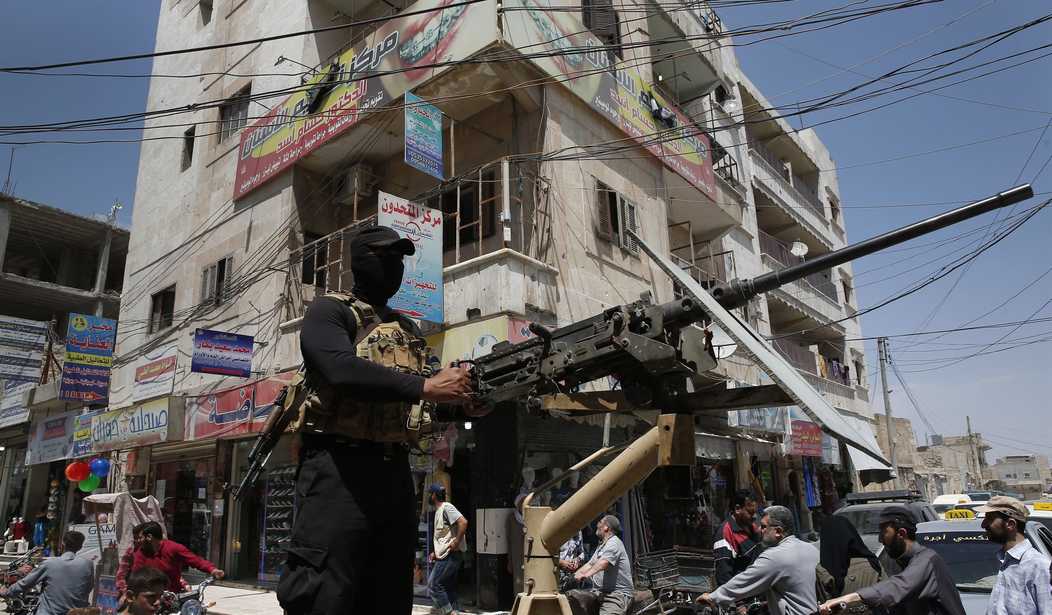
Gun control advocates seem to believe that if they pass the right set of laws, guns will somehow evaporate into the ether, like water on a Georgia sidewalk in August.
But a piece prattling on about the problem with actual weapons of war in other countries kind of proves the point that those anti-gunners are off their rockers.
Understand that when I say "weapons of war," I'm not using some supposedly clever euphemism for guns that look scary or are a little too militaristic for some people's liking. I'm talking about weapons that have actually been used in war. The United Nations seems to be concerned because those guns don't just vanish after the conflict is over. They go to the next conflict.
Years after conflicts fade from the headlines, the weapons used to fight them often continue to circulate - crossing borders, fuelling crime and undermining an often-fragile peace. Now, ghost guns, 3D-printed firearms and increasingly sophisticated trafficking networks are creating new challenges for governments worldwide.
The issue is under scrutiny as delegates gather at UN Headquarters this week to tackle the global spread of illicit firearms - weapons that continue to fuel violence in communities long after wars end.
At the centre of discussions are emerging technologies that experts warn could make these illegal weapons easier to manufacture and harder to trace.
"Wars end - but unfortunately, the weapons that are used in that particular conflict would [then] not be under full control," the UN's top disarmament official, Izumi Nakamitsu, told UN News.
"They continue to circulate. They are sometimes hidden. They are brought across borders."
...One frequently cited example is Libya, where weapons looted or diverted during and after the 2011 conflict which ended the rule of Muammar Gadaffi later surfaced across the wider Sahel region, including in Niger, Burkina Faso and Nigeria.
Some were subsequently found in the hands of extremist groups, illustrating how arms from one conflict can destabilise neighbouring countries years later.
"The end of the conflict does not mean the end of the circulation of those weapons…it stays and it continues to harm people," Ms. Nakamitsu said.
A while back, I wrote that guns are kind of like water: they go toward the low spots. When there's a low spot (read: place with high demand and difficulty meeting that demand locally), guns will flow into that low spot as a natural matter of course. This is the Law of Supply and Demand applied to armed conflict.
The truth is that guns don't just disappear. They don't vanish because they're now inconvenient. At best, they simply go to the next place with high demand.
In this case, guns intended for an armed conflict ended up in other troubled nations on the continent of Africa, almost as if that entire region has such a high degree of instability that laws are kind of viewed as more of a suggestion than a hard and fast rule for anyone to follow.
Let's understand that all of these countries have very strict gun control laws on the books. Every single nation mentioned in that piece, including the nations where the guns don't go to rebels or people like that, but criminal enterprises, all have strict gun control laws in place. Yet, because there's demand, these guns show up as if by magic, to meet that demand.
Anti-gunners here in the United States often pretend that if we pass that set of laws--whatever set it happens to be this week, because it'll be a different set next time--we won't have to worry about armed criminals or violent cartel thugs on the southern border.
But these guns flow not just around Africa, but around the world. These guns will end up with the cartels, with inner city gangs, and with any other criminal group with the money and desire.
All gun control does is make it so that regular people cannot meet the threats they might face at the hands of these heavily armed thugs.
Guns don't vanish into the ether. While the idea of taking guns from law-abiding citizens is appealing to many, the reality is that even if you could disarm the bad guys, they'd just get guns from some third-world hellscape that are a lot nastier than what we sell at the local pawn shop or sporting goods store.