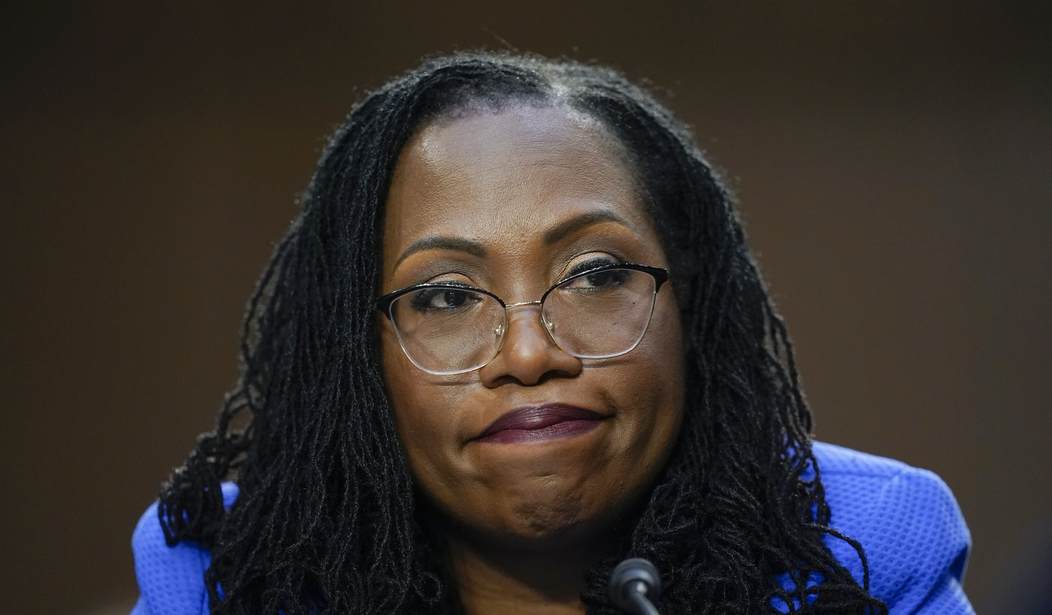
Supreme Court Justice Ketanji Brown Jackson took an interesting position in her Wolford dissent. In it, she actually argued that measures enacted prior to the 14th Amendment, which were meant to disarm black Americans following the Civil War, should be viewed as constitutional, if for no other reason than they didn't explicitly say they just applied to black people.
But the thing is, we all know what they were about.
Cam hit on that on Thursday shortly after the decision came down.
Over at The National Review, Dan McLaughlin also had thoughts about the inane commentary from Jackson.
Jackson writes this as if she is completely oblivious to both the cause-and-effect relationship between the Black Codes and the enactment of the 14th Amendment and the fact that states could violate the Second Amendment with impunity before 1868 because until then it only bound the federal government. (Of course, nearly all such states had their own state constitutional guarantees, but Jackson just blows past the distinction.) The 14th Amendment problem with these laws is not just that they would be struck down as racially discriminatory; it’s that even race-neutral laws that aimed to restrict the rights of freed black Southerners were a big reason the Republican Congress went beyond banning race discrimination and included within Section 1 of the 14th Amendment much broader guarantees against states stripping their citizens of rights. In 1865, Louisiana could ban guns or speech without violating federal law; in 1868, it could not.
Also, the fact that the laws were discriminatory in intent, often discriminatory on their face, regionally particular, broke with how white men were regulated across the country, and flew in the face of prior practice, are certainly all reasons to consider them a poor representative of an established, nationwide tradition. (Jackson cites the opinions of Daniel Sickles, but Sickles’ views of gun rights were hardly consistent, given that he shot the U.S. attorney for D.C. to death in the street for sleeping with his wife.) The race discrimination isn’t merely an embarrassing footnote; it’s in many cases a sign that laws were being imposed on the minority that the majority would not have tolerated and did not tolerate in states without large populations of newly freed slaves. In the case of the 1865 Louisiana law cited by Katyal, it should be noted that putting the burden of applying the law on the decision of a private actor (the property owner) was fairly clearly a way of ensuring that it could be applied in discriminatory fashion.
It would be a different story if these were widely adopted laws that were also used by racists for racist reasons. There are many such cases. But the Black Codes were such a prominent part of Hawaii’s argument here because there were so few other straws to grasp.
And let's be real here, while Jackson seems to think that because they weren't explicitly racist, and because they weren't overturned at the time by the courts of the era, they're somehow an acceptable analog that should be used.
However, the whole idea of historic analogs from Bruen wasn't about looking for the laws that might have prompted the 14th Amendment--one of the two eras Bruen tells judges to look at for analogs--but that were considered constitutional afterward.
To my knowledge, there were no cases that expressly upheld the law prohibiting carrying a firearm on plantation property without permission following the ratification of the 14th Amendment.
McLaughlin quotes Justice Amy Coney Barrett, "But even if Hawaii is right that the how is analogous, it also must identify an analogous why. The Black Codes were enacted to subordinate newly freed slaves. Hawaii obviously does not contend that its law promotes an analogous interest. So it's law, and the default rules in the Black Codes are not relevantly similar." She also notes that most would be happy to know that their law isn't considered racist, unlike the Black Codes.
The important distinction here is that the Black Codes, particularly this one, were purely about disarming black Americans. They were racist on the surface and were only about empowering racism. In that way, they were no different than poll taxes and land ownership requirements for voting registration. They were created explicitly to limit the rights of freed slaves who were, at this time, American citizens.
When the only measures you can find that justify your preferred policies are inherently racist, most of us would take a step back and wonder exactly what the hell we're doing with ourselves. Hawaii, and anti-gunners as a group, have no such self-awareness. They simply push the idea that laws which were unconstitutional because of how they targeted particular people at the time, as if that shouldn't matter.
I honestly don't see how either Hawaii's attorneys or these two justices were able to look at themselves in the mirror for believing such blatantly racist measures were totally fine precedents for curtailing the rights of others.
It's like looking at Ted Bundy as a role model for how to talk to girls.
Editor’s Note: The radical Left will stop at nothing to enact their radical gun control agenda and strip us of our Second Amendment rights.
Help us continue to report on and expose the Democrats’ gun control policies and schemes. Join Bearing Arms VIP and use promo code FIGHT to receive 60% off your membership.









Join the conversation as a VIP Member