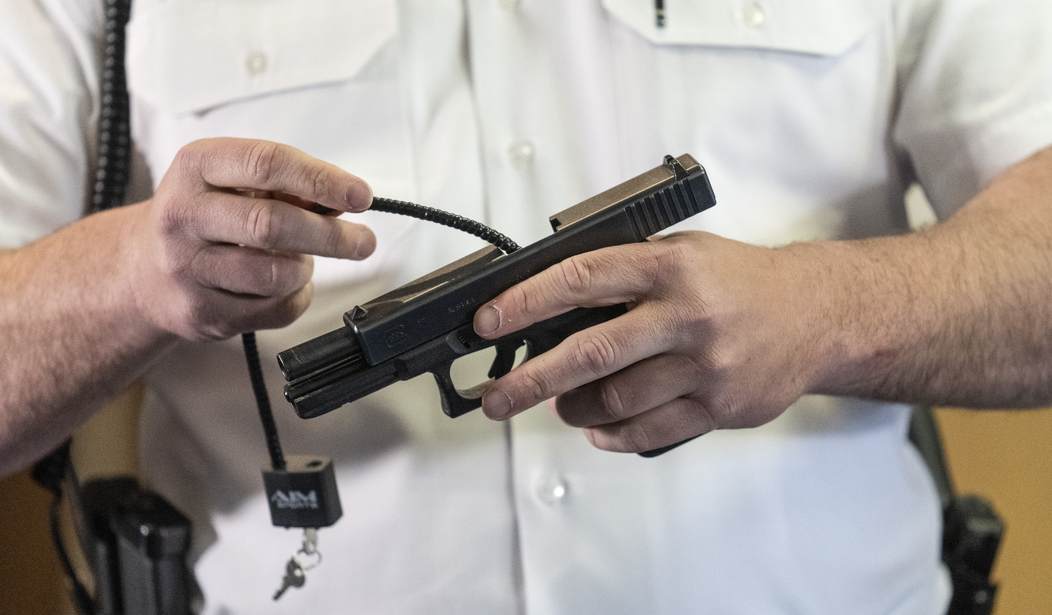
California's "red flag" law is just one of many protection order options that can be used to take away someone's guns (and ability to legally acquire them) without being convicted of a crime or being adjudicated mentally ill. Domestic violence restraining orders, workplace violence protective orders, and civil harassment restraining orders are also part of the panoply of orders that prosecutors and the public have available to them.
Now the state has made it much easier to hold an ex parte hearing for some of these orders, meaning an order can be granted without the subject of the petition taking part in the hearing or being allowed to offer up a defense.
Assembly Bill 1753, introduced by Assemblymember Catherine Stefani, D-San Francisco, doesn’t require victims to establish exceptional circumstances to get a restraining order against an accused abuser, according to an analysis of the legislation.
... According to the bill analysis, the new law does not require accused abusers to receive notification in advance that a restraining order is being filed against them. That aspect of the legislation is designed to protect those who want to file a restraining order and protect them from further harm by their abusers. Those who are subject to a temporary restraining order have to give up ammunition, and a court can search for an accused abuser’s name in the state’s Automated Firearms System database to see if the accused abuser owns a gun.
The law takes effect beginning January 1, 2028, when California courts will be prohibited from requiring advance notice to the respondent if the petitioner or their attorney certifies under oath that providing notice would likely endanger someone's safety.
Now, I can see how this could be of use in some circumstances. Someone who's been the victim of domestic violence in the past may very well be put in danger if their abuser is served with notice of a hearing on a DVRO scheduled a couple of weeks out.
The problem, though, is that the provision does not require the petitioner to submit any evidence demonstrating that advance notice would be dangerous. Their assertion is enough. They don't have to show documentation of previous threats or evidence of previous violence. It doesn't require independent corroboration of the claimed danger, nor does it require the judge to make a separate factual finding that providing notice would endanger someone.
In fact, a judge isn't even allowed to make that determination. Under AB 1753, courts will be prohibited from requiring advance notice if the petitioner or their attorney swears that providing that notice would likely endanger someone's safety.
AB 1753 seems almost designed to make ex parte hearings the norm, not the exception, once it takes effect. The law doesn't change the the existing evidentiary standards for granting these orders, but it makes it far more likely that the subject of a petition won't have an opportunity to present evidence or challenge the petitioner's allegations before a temporary order is issued.
Here's where things get even scarier. I had Washington attorney Ashley Olson on Bearing Arms' Cam & Company this week, where she talked about several clients who've lost their right to keep and bear arms through DVROs even though there's been no allegation of any threats or actual violence. In one case, Olson said a man's tears in the courtroom were enough for a judge to decide he was being emotionally manipulative and trying to control his soon-to-be-ex-wife. If you missed the interview, you can check it out below.
California's definition of "domestic violence" is just as broad as Washington's. California's guide for judges on Domestic Violence Restraining Orders states "the court may grant a request where no physical violence or threat of physical violence exists, based solely on harassment, coercive control, and/or one of the other forms of abuse listed above."
Among the behaviors that can constitute abuse in California are "telephoning/annoying calls" and "disturbing the peace," which is defined as conduct that "destroys the mental or emotional calm of the other party."
Again, Californians can already be prohibited from possessing or acquiring firearms for behavior that a judge deems to be "coercive control." AB 1753 doesn't change that. But it does make it much easier for a Domestic Violence Restraining Order, Extreme Risk Protection Order, and other protective orders to be issued without the subject of the order participating in the hearing or even knowing of its existence ahead of time.
Put these two pieces together. California law doesn't require an allegation of physical violence or even a threat of violence to obtain a DVRO. And under AB 1753, the allegation that notifying the respondent would be dangerous doesn't have to be independently established before the court proceeds without notice.
That leaves a judge potentially deciding whether to impose a temporary firearms prohibition based entirely on one side's version of events, including allegations of nonviolent conduct like coercive control, before the person whose rights are at stake has had an opportunity to respond. And that's probably going to be happening a lot more frequently in California come January 1, 2028.
Editor’s Note: The radical Left will stop at nothing to enact their extreme gun control agenda and strip us of our Second Amendment rights.
Help us continue to report on and expose the Democrats’ gun-grabbing schemes. Join Bearing Arms VIP and use promo code FIGHT to receive 60% off your membership.
Editor’s Note: The radical Left will stop at nothing to enact their extreme gun control agenda and strip us of our Second Amendment rights.
Help us continue to report on and expose the Democrats’ gun-grabbing schemes. Join Bearing Arms VIP and use promo code FIGHT to receive 60% off your membership.









Join the conversation as a VIP Member