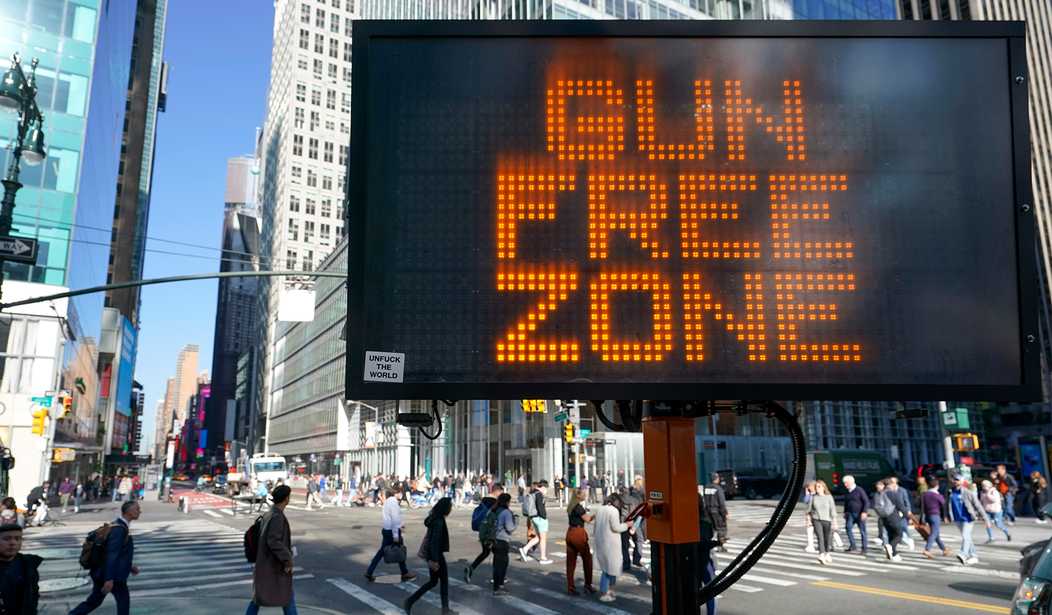

Based on Justice Clarence Thomas's comments supporting the denial of cert in Novotny v. Moore, the Supreme Court is apparently looking for the Goldilocks of "gun-free zone" cases. Not too broad, not too complicated, but just right for the justices to finally weigh in on how far states can go in restricting the right to carry.
Thomas expressed serious doubts about the constitutionality of many of the "sensitive places" adopted by anti-gun lawmakers in the wake of Bruen, but declared that Maryland's laundry list of prohibited locations presented too many distinct historical questions for the Court to tackle in a single case.
I vehemently disagree with Thomas's reasoning, as I explained earlier today, but if a narrower challenge is what it takes to get the Supreme Court to address these restrictions, then let's find one.
There are plenty of candidates to choose from, including bans on lawful carry in public parks, public transportation, restaurants that serve alcohol, and even houses of worship. Each presents its own constitutional questions, but all of them deserve scrutiny.
So which one should be at the top of the Supreme Court's list?
Second Amendment Foundation attorney Kostos Moros has a couple of suggestions.
I guess we gotta pick the worst offenders. With the vampire rule gone, for me that is parks, and restaurants serving alcohol.
— Kostas Moros (@MorosKostas) November 16, 2026
The good news for Moros is that a challenge to "gun-free" parks is already in the Supreme Court's queue. New York's response to the cert petition in Christian v. James is due on December 3, and it's possible that the justices could decide whether to grant or deny cert before 2026 draws to a close (though I think it's more likely that a decision will come in the new year). In fact, at the moment Christian v. James is the only '"sensitive places" case that's actively on the Court's docket.
Parks and restaurants serving alcohol were both part of the Novotny challenge, as was Advancing American Freedom legal scholar Amy Swearer's suggestion.
@MorosKostas And public transportation. It's one of those "tell me you don't want poor people exercising their rights without telling me you don't want poor people exercising their rights" things.
— Amy Swearer (@AmySwearer) November 16, 2026
I'm with Amy about public transportation bans, not only because of the impact it has on lower-income people dependent on mass transit to get around, but because in places like New York and Chicago it's widely used by folks on most rungs of the economic ladder. The rationale used to uphold those bans is also ridiculous. The Seventh Circuit, for example, has essentially said that because public transit can be crowded and have "vulnerable" populations like children present, it's okay to prohibit lawful carry. Under that argument, virtually every public space where people may be present could be labeled "gun-free."
As far as private property goes, I do agree with Moros that bans on carrying in places where alcohol is served should be pretty low hanging fruit, though I think that the government imposing blanket carry bans on any private property is problematic. It's one thing if the property owner decides to prohibit the practice, but I don't believe the government has the authority to demand that private businesses impose a prohibition if they don't want to.
Trying to decide which "gun-free zone" would be most ripe for Supreme Court review, or most appealing to at least four justices, may ultimately be just another exercise in frustration, though.
If the problem with Novotny was that it challenged too many gun-free zones, why couldn't the Supreme Court simply choose one and decide its constitutionality?
The justices weren't necessarily faced with an all-or-nothing choice. They could have narrowed the question and used Novotny to begin defining the constitutional limits of sensitive-place restrictions.
That doesn't mean they were obligated to do so, or that Thomas was wrong to prefer a different vehicle. But it does undercut the notion that the breadth of the challenge left the Court with no practical alternative to denying certiorari. The Court didn't need to wait for the perfect bowl of porridge, in other words. It could have taken a smaller serving of what was already on the table.
And while we're waiting for the justices to find a case that's just right, millions of Americans are still being denied the ability to exercise their right to bear arms in places they visit every day. They're not theoretical plaintiffs in some academic debate over historical analogues. They're ordinary people who have to decide whether to leave their gun at home or risk arrest and prosecution for carrying a firearm in a public park, on a subway, or while grabbing dinner at a restaurant.
I hope the Court takes up Christian v. James, but I'm not holding my breath. The justices have had multiple opportunities to address these restrictions since Bruen, and so far they've declined every invitation.
At some point, the Supreme Court needs to stop waiting for the perfect case and start doing its job. The Second Amendment doesn't guarantee the right to bear arms only in locations that five justices have gotten around to approving, and every case the Court punts gives anti-gun lawmakers another opportunity to pretend otherwise.