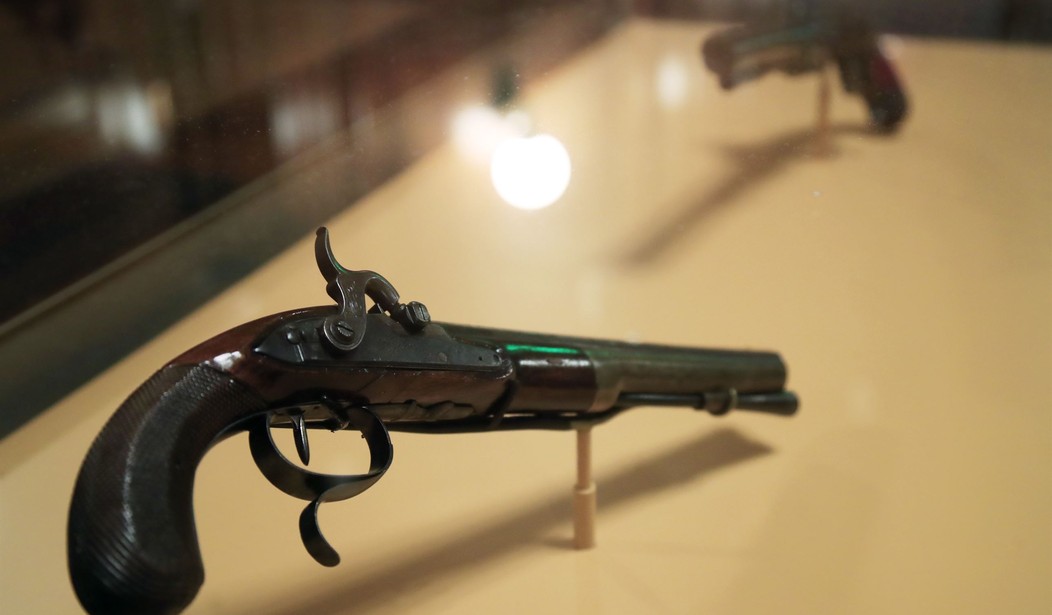
If you ask most people if a musket or flintlock rifle--yes, they're different--is a firearm, they'd say it is, and with good reason. It was considered a firearm in its prime, and by most metrics, it still is. However, legally, they're not. They're not covered by most gun laws in this country, including things like the prohibition on felons owning firearms. I wouldn't trust a DA and a jury to see it the same way, mind you, but technically, it sure looks like that's the way it goes.
And at the Associated Press, they were shocked to learn that Americans can not just buy muskets without jumping through the legal hoops on gun purchases, but we can even own cannons.
A musket from 1776 can fire a lead ball at a velocity of around 1,000 feet per second.
— The Associated Press (@AP) May 14, 2026
Imagine what that can do to a human body. Yet under federal and most state laws, it’s exempt from gun regulations. Many antique or replica guns aren’t considered firearms and even convicted… pic.twitter.com/RBT5ihazdA
From the report:
A .75-calibre Brown Bess flintlock musket, capable of firing a lead ball at 1,000 feet per second, carries the power to kill. Yet, despite this, weapons like those used by redcoats in 1776 are largely exempt from gun regulations across the United States.
This legal loophole stems from federal and most state laws, which do not technically classify many antique or replica guns as "firearms." Consequently, in numerous places, even convicted felons are permitted to own these potent historical weapons unrestricted.
"I suspect the average judge would be surprised to find that out," remarked Dave Hardy, a Second Amendment scholar and gun-rights attorney, who proudly owns two Civil War-era long guns himself.
The late actor Charlton Heston famously underscored the sentiment around such weapons during a National Rifle Association event in 2000. Hoisting a flintlock, he declared Democrats would have to take it "from my cold, dead hands." Given the current legal landscape, his concerns appear largely unfounded.
During debate over the Gun Control Act of 1968, Sen. John Goodwin Tower argued that flintlocks and many other antique or replica guns should be exempt from regulation.
The Texas Republican said it was needed “to relieve an unnecessarily burdensome problem for serious collectors of antique firearms and for historians and museums.” Treating all weapons the same, he argued, would unfairly target collector items “which have little, if any, practical use as a firearm in the modern connotation.”
The provision defines an antique as any weapon “with a matchlock, flintlock, percussion cap, or similar type of ignition system” manufactured “in or before 1898” — as long as it hasn't been modified to fire modern ammunition. This generally means muzzleloaders that use black powder or a black powder substitute, though some early cartridge guns are included.
You can even own and fire a cannon.
This is, of course, framed as a "loophole," which is just what anti-gunners say about anything that doesn't restrict a gun sufficiently in their view. Since The Independent is full of anti-gunners pretending to be journalists, here we go.
The truth of the matter is that while the piece goes on to try and highlight a few examples of these being used criminally, the reality is that it wasn't that hard to find, simply because the use of these guns for such a thing is novel enough that it'll get a lot more coverage than it might otherwise warrant.
Tower's argument of the time is still valid, especially regarding just how viable these are for most modern purposes. I think this clip from Last Man Standing kind of sums it up pretty well.
The whole gun is kind of a safety.
Now, in fairness, proper handling practices should be observed with all guns, even obsolete firearms like flintlocks, but the point stands. These aren't practical for almost anything.
Even the cap-and-ball revolvers, which are also exempted, but seem very similar to modern revolvers in both size and general form, are still less than ideal for most lawful and unlawful uses beyond having them for the cool factor.
And as for cannons, well, yeah, you can own them. You can even shoot them lawfully. Having spent my teenage years as a Civil War reenactor with my father, much of it on an artillery crew, I can assure you that even if someone truly loads them for a fight, they'll get one shot off before someone with a modern hunting rifle takes enough of the crew out that they're a non-factor.
It's not a threat to anyone, even in criminal hands, so some people need to learn to chill out.
Editor's Note: Do you enjoy Bearing Arms's conservative reporting that takes on the radical left and woke media? Support our work so that we can continue to bring you the truth.
Join Bearing Arms VIP and use promo code FIGHT to receive 60% off your membership.










Join the conversation as a VIP Member